MAKES
-
 Abarth
-
 Acura
Acura
-
 Alfa Romeo
-
 Aston Martin
-
 Audi
Audi
-
 Bentley
-
 BMW
BMW
-
 Bugatti
-
 Buick
Buick
-
 BYD
BYD
-
 Cadillac
-
 Chery
Chery
-
 Chevrolet
-
 Chrysler
-
 Citroen
-
 Cupra
Cupra
-
 Dacia
Dacia
-
 Daewoo
-
 DAF
DAF
-
 Daihatsu
-
 Datsun
-
 De Lorean
-
 DFSK
DFSK
-
 Dodge
Dodge
-
 DS
DS
-
 Ferrari
-
 Fiat
Fiat
-
 Fisker
-
 Ford
Ford
-
 GAZ
GAZ
-
 Geely
Geely
-
 Genesis
-
 GMC
GMC
-
 Great Wall
-
 Hennessey
-
 Honda
Honda
-
 Hummer
-
 Hyundai
-
 Infiniti
-
 Isuzu
Isuzu
-
 Iveco
Iveco
-
 Jaguar
-
 Jeep
Jeep
-
 Kia
Kia
-
 Koenigsegg
-
 Lada
Lada
-
 Lamborghini
-
 Lancia
-
 Land Rover
-
 Lexus
Lexus
-
 Lincoln
-
 Lotus
Lotus
-
Lucid
-
 Mahindra
-
 Maserati
-
 Mazda
Mazda
-
 McLaren
-
 Mercedes
-
 MG
MG
-
 Mini
Mini
-
 Mitsubishi
-
Morgan
-
 NIO
NIO
-
 Nissan
-
 Opel
Opel
-
 Pagani
-
 Peugeot
-
 Polestar
-
 Pontiac
-
 Porsche
-
 RAM
RAM
-
 Renault
-
 Rimac
Rimac
-
 Rivian
-
 Rolls-Royce
-
 Rover
Rover
-
 Saab
Saab
-
 Scion
Scion
-
 Seat
Seat
-
 Skoda
Skoda
-
 Smart
Smart
-
Sony
-
 SsangYong
-
 Subaru
-
 Suzuki
-
 Tata
Tata
-
 Tesla
Tesla
-
 Tofas
Tofas
-
 Toyota
-
 Vauxhall
-
 Volkswagen
-
 Volvo
Volvo
-
 XPENG
XPENG
-
 Zenvo
Zenvo

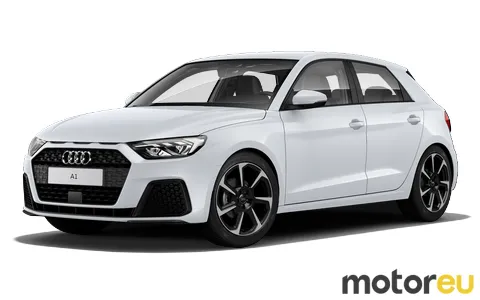
Audi > A1 Sportback 25 TFSI (95 hp) WLTP, MPG, Fuel consumption
Choose any Audi model. Find out technical specifications (engine power, dimensions, weight, fuel consumption, etc.)
 Year 2019- 2020
 Engine 999 cm3
 Power 95 hp
 Torque 175 Nm
 Gearbox Manual
  Fuel Type Petrol
 Fuel Tank 40 Liter
| Fuel Consumption |
|
|---|---|
|
Low Speed (WLTP) |
5,0 lt/100km |
|
Medium Speed (WLTP) |
3,0 lt/100km |
|
High Speed (WLTP) |
4,0 lt/100km |
Audi A1 1.0
Technical Specs
- Number of clynders 3
- Number of valves 4
- Power 95 hp
- Max output (P) 5000 rpm
- Torque 175 Nm
- Max output (T) 2000 rpm
- Wheel drive Front wheel drive
- Start&Stop Yes
- Number of doors 5
- Number of seats 5
- Tire size front 185/65R15
- Tire size rear 185/65R15
Audi A1 1.0
Technical Specs
- Vehicle Class Kleinwagen (z.B. Polo) Vehicle Class
- Body type
- Length 4.029 mm
- Width 1.740 mm
- Height 1.409 mm
- Wheelbase 2.563 mm
- Turning Circle 10.0 m
- Trunk Volume 335 liter
- Weight (Empty) 1165 kg
- Total load weight 1630 kg
- Loading capacity 465 kg
- Roof load 75 kg
Audi A1 Sportback 25 TFSI Review
2020 Audi A1 1.0’s production started in 2019 and continued in 2019 and 2020. A1 A1 Sportback GB is a 5 doors Sedan in Kleinwagen (z.B. Polo). Automobile weight is 1165 kg with 465 liters trunk loading capacity. A1 Sportback 25 TFSI has a 1,0 l Petrol engine. With 999 cc engine size it produces 95 horsepower and 175 Nm torque. The power is transmitted by a 5 speed Manual gearbox with Front wheel drive wheel drive. Vehicle can accelerate from zero to 100 km/h (60 mph) in 10.0 seconds. Top speed is limited by 191 km/h (119 mph). The engine has a Euro 6d-TEMP (WLTP) standard. Fuel tank capacity is 40 liters. Automobile is equipped by Start & Stop feature Consumption in city is 5.0 lt/100km, consumption in highway is 3.0 lt/100km and combined fuel consumption is 4.0 lt/100km according to official factory data. Estimated A1 Sportback 25 TFSI real World MPG/consumption is 6,5 lt/100km. It is expected to consume 50 percent more fuel than factory data in real conditions and during test drives.